E-mail not displaying correctly? View it online. |
|
|
|
|
Feature of NotePercy Grainger’s Percussion Innovations
|
|
|
Above: Jordan Waddell discussing the staff bells during his October 4th Sunday Tour |
What can a small tabletop xylophone tell us about Percy and Ella Grainger? Quite a lot, as it turns out. Jordan Waddell—a summer 2026 volunteer at the Percy Grainger House who recently earned his master’s degree from the University of Hartford—explored the couple’s remarkable interest in percussion during his Sunday Talk at the Percy Grainger Home & Studio on Sunday, October 4, 2026.
The program began with a rare, compact practice xylophone, circa 1930, made by Brooklyn’s R. H. Mayland Company. With its portable design, felt supports, and clearly marked notes, it was made for learning—not the concert stage. The Graingers even added larger white note labels for easier use.
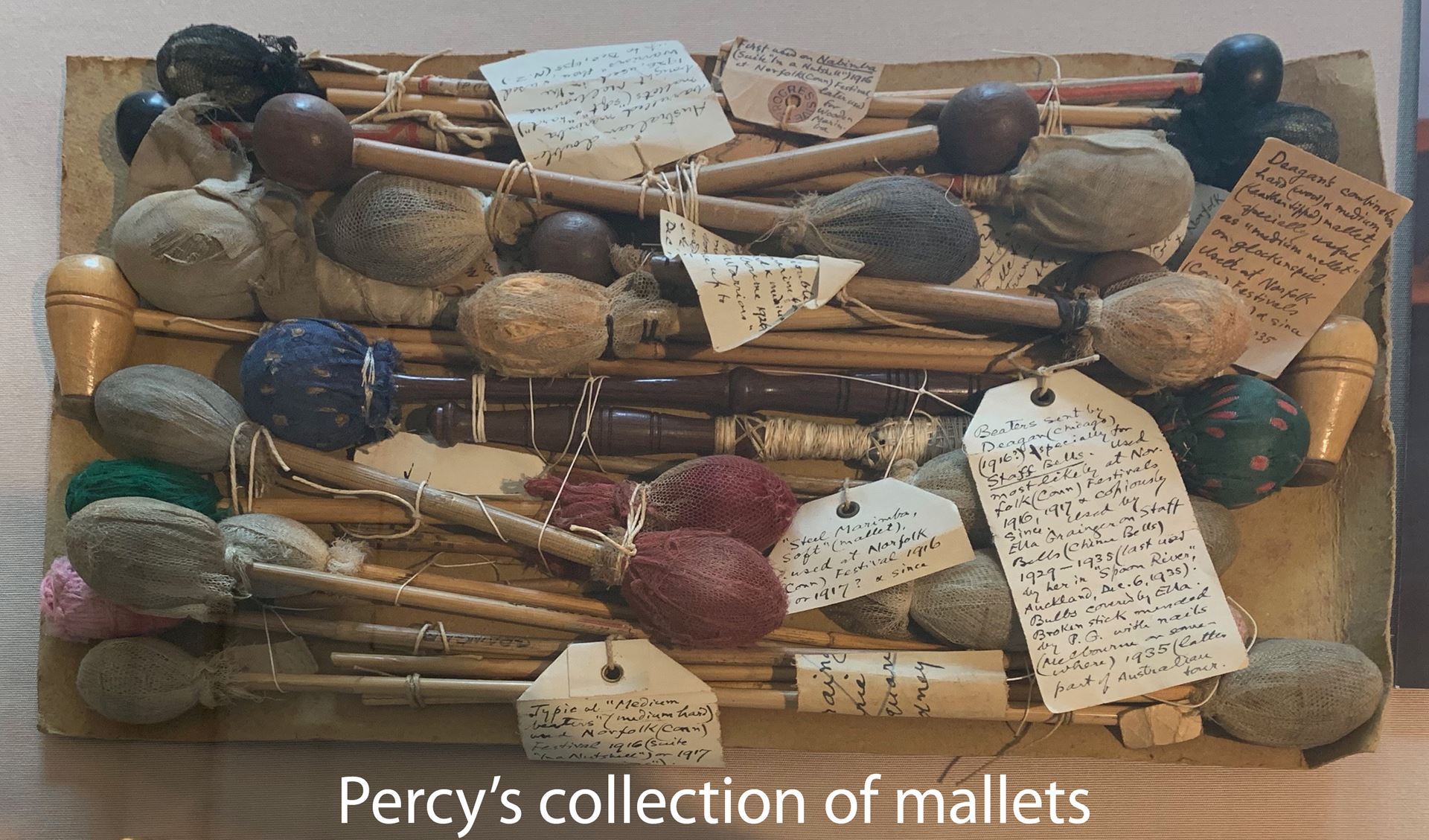
Waddell also introduced Grainger’s unusual staff bells: gentle, clapperless bells struck with mallets to create an almost ethereal sound. Percy wrote for them often and lent sets to musicians performing his works.
A 1949 xylophone practice pad, created by Percy from kraft paper, cardboard and ink, showed that the Graingers were ahead of the curve; similar practice products only became widely available decades later. The talk ended with The Warriors, Grainger’s enormous “Music to an Imaginary Ballet,” calling for about 12 percussionists and several pianists. Clearly, Grainger loved ambitious sounds—and knew exactly how to create them.
PGS is grateful to Jordan for his volunteer efforts and this recent talk.
Live near or are visiting the NYC area? Consider presenting a Sunday Tour at the Percy Grainger Home & Studio. Guidelines are here. Click the photo below to view more photos from Jordan's tour! |
|
|
|
|
At the Home and StudioThe "Century of Percussion," and Percy Grainger's Place In It
|
|
|
Along with the recent Sunday Tour highlighting Grainger's use of percussion, we now turn to Chalon Ragsdale's exploration of Grainger's "tuneful percussion." In a post for the PGS blog, Ragsdale, a PGS board member and the Associate Editor of The Grainger Journal, shared: Percy Grainger’s status as an innovative genius in the area of orchestration is reinforced for me practically with each score of his I have the good fortune to study. His knowledge of the instruments is an important factor, his search for new and unique combinations of instruments is an important factor, but perhaps the most important factor in the brilliance of his orchestration is his democratic respect for each instrument’s worth and ability to contribute positively to the total fabric (Grainger might say the “weft”) of the music. Though I am constantly amazed at Grainger’s use of all the instrumental and choral resources at his disposal at any one time, as a percussionist myself, I am most keenly struck by Grainger’s brilliant use of the mallet-played percussion; what he termed the “tuneful percussion." Grainger’s transformational energy found fruit in a new model of orchestration in the early years of the 20th Century, as expressed most convincingly in his large orchestral works The Warriors and Suite: In a Nutshell. Grainger continued the work of Wagner and Mahler in completing the woodwind and brass families of the orchestra; but he also created a new family of instrumental color by combining the “tuneful” percussion with harp and the various keyboard actuated instruments (piano, celesta, dulcitone, etc.).
Read the full blog post through this link to the PGS website. If you have content or an idea for a blog post, we would love to hear from you! Take a moment to review the notes for contributors here.
|
|
|
|
Member HappeningsHave You Heard the Aural Histories?
|
|
|
Above: Snapshot from the dining room in the Percy Grainger Home & Studio |
Did you know that a special collection of aural histories is available on the Percy Grainger Society website?
Created in celebration of the Society’s 60th-anniversary in 2024, Corresponding Secretary Emeritus, Dana Paul Perna, recorded interviews with previous Presidents and Board Members of the Percy Grainger Society, staff, and friends.
Included in the collection are interviews with:
- Ella Viola Grainger Manville
- Barry Peter Ould
- Stewart Manville
- Eric Culver
- Philip Brunelle
- Joseph Kreines
- R. Mark Rogers
The aural histories collection is accessible to both PGS members and non-members. Make sure to visit the page today! |
|
|
Registration ReminderOctober 22, 2026:
Staging Percy Grainger Session 1: Percy and Rose
|
|
|
|
|
About the session: Rob George, creator of Percy and Rose (1982), opens the series of virtual programs with a searching exploration of Grainger’s emotional world and personal relationships. Inspired by archival sources, George traces how private longing and human connection can be shaped into compelling fiction, revealing how the stage can capture both the vulnerability and intensity that defined Grainger’s inner life.
The entire series is moderated by Percy Grainger Society member Sarah Kirby, a research fellow at the Grainger Museum, University of Melbourne. Her second monograph, Inventing Percy Grainger: The Construction of Biography on Page, Stage and Screen, was published by Boydell & Brewer in 2026. |
|
|
|
|
|
|
The Percy Grainger Society remembers Keith Brion with gratitude for his contributions to music education and his commitment to preserving Percy Grainger’s legacy.
Keith came to know Ella Grainger and helped establish a Percy Grainger collection at Upsala College in New Jersey. His work helped make Grainger materials available to those who would study and share the composer’s music. Keith’s influence was also deeply personal. Society board member Bill Garlette knew him first as his high school band director. Like so many of Keith’s students, Bill carried forward the encouragement and love of music he found in Keith’s classroom.
Keith’s advocacy for Sousa’s music also included recognizing Sousa’s support for Percy Grainger. Sousa was among the influential conductors who programmed and promoted Grainger’s music, helping bring it to audiences at a time when Grainger’s distinctive voice was still gaining broad recognition. Keith understood this connection between the two composers and helped keep alive an appreciation for the musical friendship and mutual respect that linked them.
The Society is grateful for all Keith contributed—as a teacher, conductor, scholar, preservationist, and advocate for both Grainger and Sousa. We extend our sympathy to Keith’s family, friends, colleagues, and former students. We will remember him with appreciation for his work, his teaching, and the lasting influence he had on those who knew him. |
|
|
Event KeyThe Percy Grainger Society is pleased to offer both live and virtual events. You can easily determine if the events listed in this newsletter are live or virtual by the color of the registration button: green for live events blue for virtual events
|
|
|
The Percy Grainger Society
7 Cromwell Place | White Plains, New York 10601
Join/Renew
Donate
Volunteer
Our mission is to promote the work and legacy of Percy Grainger with a membership community that preserves his historic house, encourages appreciation performance of his music, and promotes a deeper understanding of the cultural, social, and economic context of his life and work.
info@percygrainger.org
(914) 281-1610
www.percygrainger.org
Having trouble viewing this email? Visit the newsletter archive. |
|
|
|